


























SFM Compile: Your Complete Guide to Making Custom Models Work

Source Filmmaker is a great tool to learn animation with, but one of the most important things many people starting with it have a hard time with is getting custom models to actually work. This is where SFM compile comes in.
What Is SFM Compile and Why You Need It
SFM compile is the process of converting raw 3D model files into formats that can be read and displayed by Source Filmmaker. A downloaded model or a self-created model will generally be in SMD or DMX files. They will not work in SFM until you organize them into MDL files.
You can imagine it as translating a document. The Source engine only listens to one language, and your beautiful 3D model speaks another. The compilation process bridges this gap so that you can be sure your models load correctly with the right textures, bones, and animations.
Without proper SFM compile, you will get pink and black checkerboard textures, missing models, broken animations, or even crashes. Learning this process opens endless creative potential in Source Filmmaker.
Essential Tools to Compile in Source Filmmaker
Three primary tools will be required to assemble models. Each has its purpose in the workflow.
Studiomdl is packaged with the Steam SDK. This is a command line utility which interprets QC script files and generates MDL outputs. Although it is simple, it is a trusted tool that manages most compilation requirements. It is located in your SFM installation in the bin folder.
Crowbar simplifies the whole process a lot. This is a free tool that has a visual interface for compiling and decompiling models. You don’t have to type in commands, you just drag and drop your QC file and then click compile. The majority of creators use Crowbar due to clear error messages and the ability to process in batches.
HLMV (Half-Life Model Viewer) provides a preview of compiled models before you test them in SFM. You are able to check textures, bone movements, and physics meshes. This preview step saves hours of troubleshooting later.
Understanding QC Files in SFM Compile
The QC file serves as your blueprint in the SFM compile. This text file tells the compiler how to construct your model. Any successful compile begins with a well-written QC file.
There are some important elements that your QC file should contain. The $modelname line determines the final name of your MDL file. The textures are referenced in the $cdmaterials line. The main mesh file is mentioned in the $body line. All paths need to be correct, or the compile will fail.
The simplest form looks like this: The $modelname needs to be the name of your project, the $cdmaterials needs to use forward slashes to your texture folder, and the $body reference needs to point to the exact SMD file. The paths are case-sensitive, and even a small typo ruins everything.
Common errors in QC files include incorrect slashes in paths, missing dollar signs before commands, and wrong material directories. QC files should always be saved as ANSI, not UTF-8. Simple models should be tested before more complex characters are attempted.
Step by Step SFM Compile Process
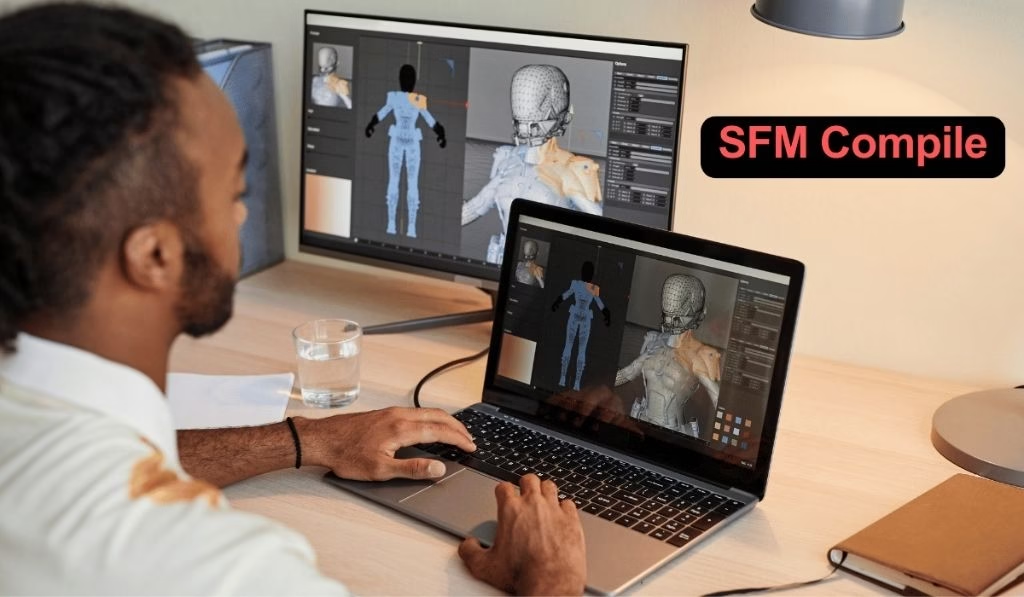
It only takes ten minutes to get your model compiled once you know the workflow. These steps should be taken in sequence to avoid major errors.
To begin with, organize your files. Make a models folder for SMD files and a materials folder for textures. Your folder structure should reflect the way SFM expects to find files. Wrong organization causes path errors in compilation.
Next, prepare your textures. Source Filmmaker supports images in VTF format and VMT files that describe how the textures behave. Use VTFEdit to convert TGA or PNG images into VTF. Create a simple VMT file which references your VTF texture.
Open Crowbar and load your QC file. Choose the output directory where compiled files should be saved. Click the compile button and watch the log window. If errors appear, the log points to the problem line in your QC file.
Once compilation succeeds, you will have several files: MDL contains your model data, VVD has vertex information, VTX has rendering information, and PHY has physics properties. These files work together, so keep them in the same folder.
Finally, copy files to your SFM usermod directory. Navigate to SourceFilmmaker/game/usermod/models and place your files there. Open SFM, create a new scene, and find your model in the asset browser.
Testing Your Compiled Model
You must verify that everything is working before you celebrate. Errors are easier to fix when caught early.
Load HLMV first. Open your MDL file and rotate the model at every angle. Confirm that textures load without pink checkerboard. Move the bones by clicking on various skeleton parts. Test that physics collision meshes are enabled when they should be.
Next, import the model into SFM. Place it in a scene and try simple poses. Use the manipulator tools to move the bones. Test default animations if you added any. Check how lighting behaves on the surface and how materials react.
Watch out for common problems: Models that sink through the floor need fixes in the QC file. Twisted limbs show that there is an issue with bone orientation in your starting mesh. Missing textures indicate incorrect paths in your VMT files.
Read more: Is Ingredients in Qoghundos Good? 2026 Health Facts
Common SFM Compile Errors and Solutions

Even experienced creators make mistakes in SFM compile. Knowing how to fix them saves a lot of frustration.
Purple checkerboard patterns indicate that Source cannot find your textures. Make sure your $cdmaterials path in the QC file matches your actual folder structure. Check that VMT files reference the correct VTF textures. Remember that paths are case-sensitive on some systems.
Exploding bones or distorted models are usually caused by reference and animation SMD files having different bone structures. Export all SMDs from the same rig in Blender. Verify that bone names are identical in all files.
Compiler crashes happen frequently with special characters in file names or paths containing spaces. Change file names to use only letters, numbers, and underscores. Keep paths short and avoid too many nested folders.
Models that don’t appear in SFM probably mean incorrect output directory. Compiled files should be in the usermod/models folder. Make sure you are looking in the correct folder in SFM’s asset browser.
Advanced SFM Compile Techniques
These advanced techniques boost your productivity and improve quality after you have mastered the basics.
Process multiple models with batch compiling. Write a batch file that runs studiomdl on several QC files at once. This method is excellent when you need to update many models with similar settings.
LOD (Level of Detail) models reduce polygon count at various distances. Add $lod commands to your QC file that reference simplified versions of your mesh. This optimization makes SFM run smoothly in complex scenes.
Facial flexes allow you to animate expressions. Add $flex commands to your QC that specify how vertices move for different emotions. This involves careful vertex weighting in your 3D package, yet it creates professional character animation.
Enhance physics interactions with custom collision models. Use a simplified version of your visual mesh instead of the full detail version. Add it in the $collisionmodel section of your QC file with appropriate mass settings.
How to Optimize Models for Better Performance
Optimized models run faster and crash less during long projects. These optimization strategies make a real difference.
Reduce polygon count in areas that viewers won’t see up close. SFM handles low-poly models much better than high-density meshes. Use the decimate modifier in your 3D software, then export to SMD.
Compress your textures. Big 4K textures look excellent but will hurt performance. Most models work fine with 1K or 2K textures. Save VTFs as DXT compressed files to reduce file size.
Minimize bone count where possible. Complex rigs with hundreds of bones slow down SFM dramatically. Combine bones that always move together. Remove bones that don’t cause visible deformation.
Use proper texture resolution for model size. Tiny props don’t need huge textures. Match resolution to how close viewers will see the model in typical shots.
SFM Compile Community Resources
You are not alone in this journey. The Source Filmmaker community offers amazing support and resources.
SFM communities connect creators through Discord servers and forums. Members share models, troubleshoot issues, and hold compile nights where everyone works together on projects. You get step-by-step help with specific errors and workflows.
Steam Workshop contains thousands of ready-to-use models and textures. Study how advanced creators organize their files. Download working models and decompile them with Crowbar to see example QC files.
YouTube tutorials cover every aspect of SFM compile. Find solutions to the specific problems you have. Many creators show their entire workflow, displaying exactly what settings they use.
SFMlab offers asset libraries made specifically for Source Filmmaker. The site organizes models by type and game, making it easy to find reference materials for your projects.
Troubleshooting Your Workflow

When compilation fails, systematic troubleshooting gets you back on track faster than random guessing.
Check the compile log first. Look for error messages with line numbers that point to issues in your QC file. Don’t guess what went wrong, read the error message carefully.
Test simple models before complex ones. If a basic cube compiles and your character doesn’t, the problem is with your character mesh or rig, not your tools or setup.
Verify file paths manually. Open Windows Explorer and confirm that files exist at the locations your QC file specifies. One misplaced letter breaks everything.
Compare with working examples. Find a model that compiles successfully and match its file structure to yours. Copy the folder organization and path writing style.
Start fresh if needed. Sometimes it’s quicker to recreate your QC file from scratch with known good paths than to hunt for elusive errors in an old file.
FAQs
What does SFM compile mean?
SFM compile is the conversion of 3D model files like SMD or DMX into MDL format which can be loaded and animated by Source Filmmaker. It transforms your mesh, textures, bones, and animations into a format that the Source engine understands.
What tools are required to compile SFM models?
Compilation requires Studiomdl or Crowbar, texture work needs VTFEdit, QC files need a text editor, and testing uses HLMV. All these tools are free and work with Windows systems running Source Filmmaker.
Why do my compiled models have pink textures?
Pink checkerboard textures indicate missing materials. Check that your $cdmaterials path in the QC file points to where you saved VMT files. Verify that VMT files use correct paths to your VTF textures.
Can I compile models from other games and use them in SFM?
Yes, but you need to decompile them with Crowbar first, then recompile with correct paths for SFM. Be aware of copyright issues and only use content you have permission to modify. Game assets usually need texture path fixes when recompiling.
How long does SFM compile take?
Simple props compile in seconds. Complex characters with animations may take several minutes. Actual compile time depends on your computer speed and model complexity, but most compilations finish in less than a minute.
What is the difference between MDL files and SMD files?
SMD is editable source data exported from 3D software. MDL files are game-ready files that Source Filmmaker can load. The compilation process uses SMD files to generate MDL files.
Does SFM compile require programming knowledge?
No programming is required. QC files use simple text commands with basic syntax. The format is learned quickly by following examples and tutorials. Basic file organization knowledge is more important than coding skills.